When Mathematics Begins Questioning Reality

Updated: Jul 27
For centuries, mathematics has stood like a cathedral in the human imagination, clean lines of certainty rising above the chaos of ordinary life. Wars come and go, governments collapse, beliefs evolve, yet two plus two remains four. Equations orbit through time untouched by emotion, culture, or opinion. Mathematics has long been treated as the closest thing humanity possesses to absolute truth.
Yet beneath that marble surface, something unexpected has been unfolding.
Some of the world’s greatest mathematicians are no longer simply solving equations. They are questioning the very foundations upon which mathematics itself was built. Quietly, almost invisible to the wider public, a philosophical reckoning has been taking place. The deeper mathematicians travel into infinity, logic, geometry, and proof, the stranger reality begins to feel.
What emerges from these explorations is not merely a technical debate confined to universities and chalkboards. It is a profound human story about certainty, consciousness, paradox, and the limits of understanding itself.
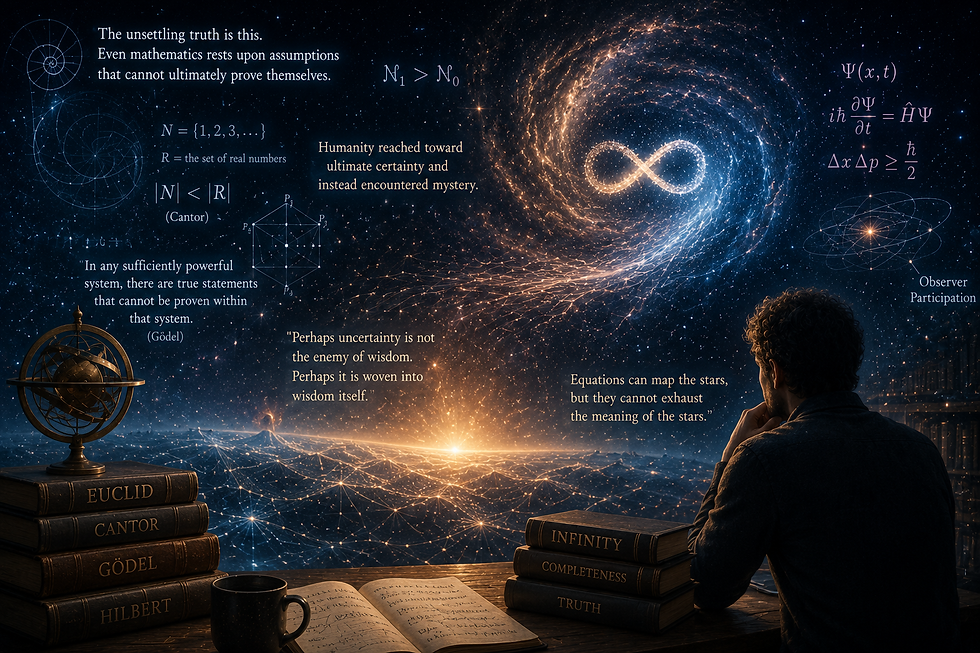
The unsettling truth is this. Even mathematics rests upon assumptions that cannot ultimately prove themselves.
That realisation carries an almost spiritual weight.
At the heart of the modern mathematical crisis lies infinity. Infinity appears simple at first glance, almost poetic. Endless stars, endless space, endless possibility. Ancient mystics spoke of the infinite as the face of the divine, something beyond human comprehension yet deeply woven into existence. But when nineteenth century mathematician Georg Cantor attempted to formalise infinity mathematically, he opened a doorway that changed everything.
Cantor discovered that infinities could have different sizes. Some infinities were larger than others. The infinite set of counting numbers was somehow smaller than the infinite set of real numbers. Logic bent in impossible directions. The mind struggled to follow.
Many of his contemporaries believed he had gone too far. Some considered his work dangerous. Others thought it bordered on madness. Yet Cantor persisted, driven by an intuition that infinity was not merely abstraction but something real, something embedded in the architecture of existence itself.
There is something deeply symbolic in this moment. Humanity reached toward ultimate certainty and instead encountered mystery.
The deeper mathematics ventured, the more reality seemed to dissolve into paradox.
This tension only intensified in the twentieth century when Kurt Gödel introduced his incompleteness theorems. Gödel demonstrated that within any sufficiently powerful mathematical system, there will always be truths that cannot be proven from within the system itself. No matter how elegant the structure, there are limits to what it can explain about itself.
It was a revelation that shattered the dream of total certainty.
For generations, mathematicians had hoped they could construct a flawless logical framework capable of proving every mathematical truth. Gödel showed this dream was impossible. Every system rests upon assumptions it cannot fully justify.
In many ways, this mirrors the human condition.
Every worldview, scientific, spiritual, or philosophical, eventually encounters its own horizon. Beyond that horizon lies mystery. We build languages to describe reality, yet reality always exceeds the language. We create systems of meaning, yet existence remains larger than the systems we invent.
This does not weaken truth. If anything, it makes truth more alive.
Modern culture often treats uncertainty as failure. We are conditioned to seek definitive answers, permanent identities, rigid ideologies. Yet mathematics itself now whispers something more subtle. Perhaps uncertainty is not the enemy of wisdom. Perhaps it is woven into wisdom itself.
There is a quiet humility emerging from the frontiers of mathematics. The recognition that knowledge has edges. That logic alone cannot contain the totality of existence. That mystery is not a temporary flaw waiting to be solved, but an enduring feature of reality.
Strangely, this realization brings mathematics closer to ancient spiritual traditions than many might expect.
Buddhist philosophy has long taught that reality cannot be fully grasped through conceptual thought alone. Taoist teachings speak of the Tao as something that cannot truly be named. Mystics throughout history have described encounters with truths that transcend language and collapse ordinary categories of understanding.
Even quantum physics has begun echoing this pattern, revealing a universe that behaves less like a machine and more like a living field of probabilities, relationships, and observer participation.
Now mathematics, humanity’s most trusted language of certainty, appears to be arriving at a similar threshold.
This does not mean mathematics is becoming mystical in the supernatural sense. Equations still work. Bridges still stand. Technology still functions. Rather, it reveals that reality may be more profound than the frameworks we use to measure it.
There is beauty in that realisation.
For many people, spirituality begins precisely where certainty ends. Not in blind belief, but in the willingness to sit beside mystery without needing to conquer it. To recognise that existence may contain dimensions beyond complete intellectual ownership.
In this way, the current evolution within mathematics feels deeply human. It reflects our own inner journeys. We spend much of life searching for stable ground, fixed answers, permanent structures. Yet growth often arrives through paradox. Through uncertainty. Through discovering that truth is not always a destination but an unfolding relationship with the unknown.
What makes this moment especially fascinating is the rise of artificial intelligence and machine assisted proof systems. Computers are now capable of verifying mathematical proofs beyond the capacity of any single human mind. Some mathematicians are beginning to rely on systems they cannot fully comprehend line by line.
Again, the symbolic resonance is difficult to ignore.
Humanity created machines to help us pursue certainty, only to encounter new layers of opacity and dependence. The tools designed to illuminate truth are themselves becoming increasingly mysterious.
It raises profound philosophical questions. If a proof is too vast for human understanding, does understanding still matter? If truth can be mechanically verified without direct human comprehension, what becomes of intuition, insight, and meaning?
These are no longer abstract academic concerns. They touch the future of consciousness itself.
We are living through an era in which old foundations are shifting across every domain. Institutions, identities, technologies, and belief systems are all being questioned simultaneously. In many ways, mathematics simply reflects a deeper transformation occurring within the collective psyche.
The age of rigid certainty is softening.
What emerges in its place may not be chaos, but a more mature relationship with reality. One that honours logic while also respecting mystery. One that values knowledge without worshipping control. One that understands that truth can be both precise and infinite at the same time.
Perhaps this is the deeper lesson hidden within the evolving foundations of mathematics. Not that certainty is impossible, but that reality is richer than certainty alone.
There is something strangely comforting about that.
The universe remains intelligible enough for us to explore, yet mysterious enough to inspire awe. Equations can map the stars, but they cannot exhaust the meaning of the stars. Logic can describe patterns, but it cannot fully contain existence itself.
And maybe that is exactly how it was always meant to be.
Somewhere between proof and paradox, between infinity and silence, humanity continues its ancient search for understanding. And perhaps the greatest discovery is not that every mystery can be solved, but that some mysteries deepen our appreciation of reality simply by inviting us to explore them.


Comments