The Rise of the Intuitive Generation

Updated: Jul 27
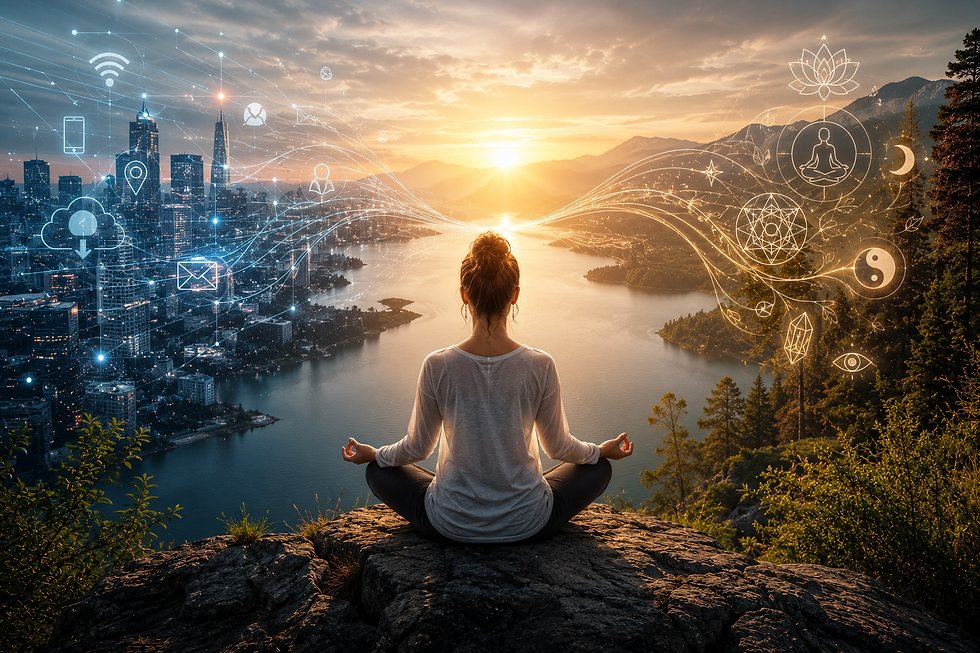
Something has been happening over the past decade that I don't think enough people are talking about.
At the same time artificial intelligence is becoming more powerful, technology is becoming more integrated into our lives, and we have access to more information than any generation before us, there has also been a huge surge of interest in meditation, mindfulness, breathwork, astrology, tarot, consciousness, energy healing and intuition.
Twenty years ago, many of these topics sat well outside mainstream conversation. Today they're discussed by athletes, business leaders, psychologists, celebrities and millions of ordinary people. Meditation apps have been downloaded hundreds of millions of times. Podcasts exploring consciousness regularly top the charts. Books about intuition and self-awareness continue to become bestsellers.
That raises an interesting question.
Why are we becoming more interested in looking inward at exactly the same time we're becoming more technologically advanced?
For a long time, our culture seemed convinced that every problem could eventually be solved through science, technology and data. If something couldn't be measured, tested or quantified, it was often pushed aside as subjective or unreliable. We became incredibly good at understanding the external world, but somewhere along the way many people began to feel disconnected from their internal one.
Today we can ask artificial intelligence almost anything. We carry the world's knowledge around in our pockets. We can communicate instantly with someone on the other side of the planet. Yet despite all of this progress, many people still feel anxious, disconnected and uncertain about who they are or where they're heading.
That tells me information and wisdom are not the same thing.
Knowing more doesn't automatically help us understand ourselves. It doesn't tell us why we feel empty despite being successful, why certain relationships never seem to work, or why we sometimes know deep down that something is wrong before we can logically explain it.
Those are the kinds of questions that have always led people inward.
Most of us have experienced intuition at some point, even if we don't use that word. It might be a gut feeling about a situation, an immediate sense of trust or caution around someone we've just met, or a decision that simply feels right long before we can explain why. Sometimes we ignore those feelings and later wish we hadn't.
Science offers one explanation. Our brains are extraordinary pattern-recognition machines. They absorb tiny details that never reach conscious awareness, allowing us to make rapid judgements based on subtle information we didn't even realise we'd noticed.
That makes a lot of sense.
At the same time, it's also true that people across virtually every culture and throughout recorded history have spoken about intuition as something deeper than unconscious pattern recognition. Whether they called it inner knowing, wisdom, spirit or simply listening to the heart, the idea itself is far from new.
I'm not convinced we need to choose one explanation over the other.
Perhaps intuition involves biology. Perhaps it involves consciousness in ways we don't yet fully understand. Perhaps it's a combination of both. The honest answer is that we don't know.
What I do know is that millions of people are becoming curious enough to explore it.
I don't think that's happening because society is becoming less intelligent. If anything, I think it's happening because people are recognising that intelligence alone doesn't answer every important question in life.
Technology is extraordinary, but it can't tell you whether you're living authentically. Artificial intelligence can summarise books, write code and solve complex problems, but it can't tell you what gives your life meaning. It can't decide who you should become or what kind of relationships will fulfil you.
Those remain deeply human questions.
Maybe that's why so many people are returning to practices that encourage stillness rather than stimulation. Meditation, mindfulness, journaling and breathwork all ask us to do something modern life rarely encourages.
Slow down.
Pay attention.
Notice what's happening beneath the constant noise.
Healthy scepticism should always be part of that process. Not every spiritual claim deserves to be believed, and critical thinking is just as important in the world of intuition as it is anywhere else. But there is a difference between questioning something and dismissing it before we've genuinely explored it.
History is full of ideas that were once ridiculed before becoming accepted. Curiosity has always moved humanity forward, whether that curiosity was directed towards the stars, the atom or the human mind itself.
Perhaps the growing interest in intuition isn't a rejection of science or technology at all. Perhaps it's a recognition that human beings need both external knowledge and internal wisdom. We need logic, but we also need self-awareness. We need evidence, but we also need meaning.
As artificial intelligence continues to evolve, I suspect that balance will become even more important. The more capable our machines become, the more valuable uniquely human qualities may become. Reflection. Creativity. Compassion. Presence. The ability to sit quietly with ourselves and listen to something deeper than the next notification.
Maybe that's what this renewed interest in intuition is really about.
Not escaping the modern world.
Learning how to stay human within it.


Comments