KP7 Geomagnetic Storm Follows Week of Solar Activity as Earth Remains Under Space Weather Watch

Updated: Jul 26
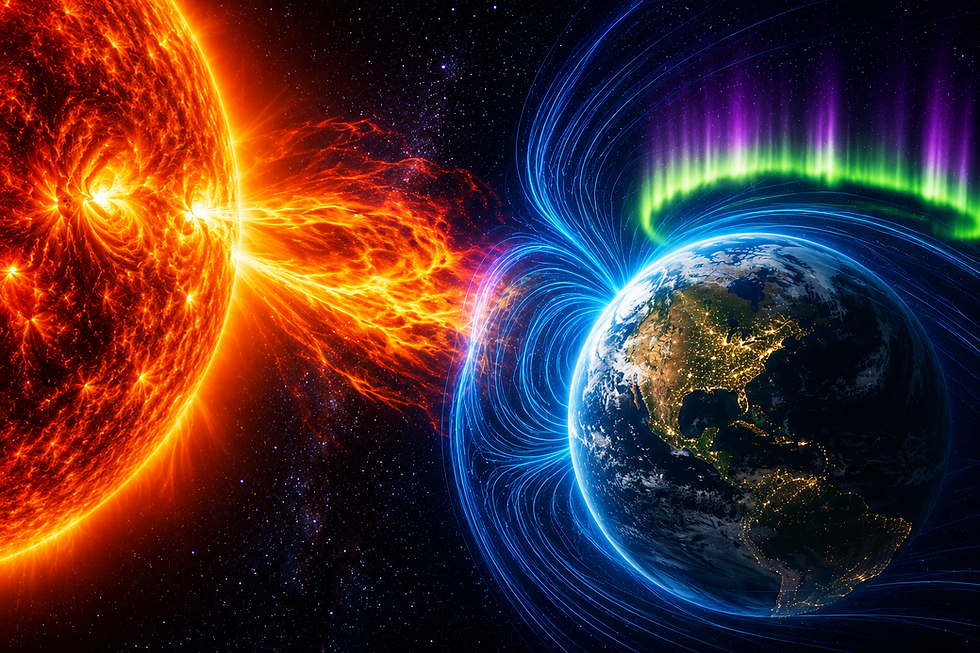
Earth’s magnetic field remains unusually active following a series of solar eruptions that have triggered multiple geomagnetic storms over the past week, with conditions recently reaching KP7 as forecasters continue monitoring additional solar activity moving through space.
For skywatchers, space weather enthusiasts, and those who closely follow solar activity, the past week has been one of the most significant periods of geomagnetic disturbance in recent months. What began with a powerful series of solar flares and coronal mass ejections has evolved into an extended period of magnetic unrest around our planet, with forecasts suggesting the story may not be over just yet.
At the time of writing, geomagnetic activity has reached KP7 levels, placing the current event within strong geomagnetic storm territory. The elevated readings follow several days of solar activity that have repeatedly impacted Earth’s magnetic field, creating visible auroras across parts of the world and prompting ongoing monitoring by space weather agencies.
The latest activity can be traced back to a highly active region on the Sun that produced a series of significant eruptions during the first week of June. Among them was an X1-class solar flare, accompanied by multiple M-class flares and several Earth-directed coronal mass ejections, commonly known as CMEs.
These immense clouds of charged solar particles travel through space and, when directed toward Earth, can interact with our planet’s magnetic field. The result is often an increase in geomagnetic activity, producing everything from enhanced auroras to temporary disruptions in radio communications, satellite systems, and navigation technologies.
Forecasters quickly recognised the potential significance of the eruptions and issued geomagnetic storm watches as the solar material made its way toward Earth. Over subsequent days, multiple CMEs arrived, producing moderate to strong geomagnetic conditions and keeping Earth’s magnetosphere in a prolonged state of disturbance.
While some of the earlier impacts peaked below the most extreme forecasts, the cumulative effect of several successive solar events has created an extended period of heightened activity that continues to unfold.
The latest surge to KP7 suggests that Earth’s magnetic field is still responding to incoming solar energy. A KP index of 7 indicates strong geomagnetic storm conditions and reflects substantial disturbances within the magnetosphere as it absorbs and redirects charged particles arriving from the Sun.
Current forecasts indicate that elevated geomagnetic conditions may continue through the coming days. Space weather agencies have maintained geomagnetic storm watches extending into the next forecast period, with the potential for both G2 (Moderate) and G3 (Strong) storm levels depending on how incoming solar material interacts with Earth’s magnetic field.
One of the key variables remains the orientation of the magnetic field embedded within arriving CMEs. Even powerful solar eruptions can produce relatively modest impacts if their magnetic orientation does not strongly couple with Earth’s magnetic field. Conversely, a favourable alignment can rapidly intensify geomagnetic conditions and increase storm strength.
Scientists are therefore continuing to monitor solar wind speeds, magnetic field orientation, and activity from several active regions currently facing Earth.
The broader context is also worth noting.
The Sun remains near the peak of Solar Cycle 25, the approximately 11-year cycle of solar activity that governs the frequency of sunspots, solar flares, and coronal mass ejections. As a result, periods of heightened geomagnetic activity are becoming more common, with increased opportunities for both scientific observation and visible auroral displays.
For many people, these events are simply fascinating reminders that Earth exists within a dynamic cosmic environment. The magnetic field surrounding our planet is constantly interacting with solar activity, protecting life on Earth while simultaneously producing some of nature’s most spectacular displays.
Others pay close attention to geomagnetic activity because they believe changes in Earth’s magnetic environment may influence human wellbeing, mood, sleep patterns, or energy levels. While scientific research remains ongoing and evidence remains limited, reports from individuals who track solar activity often increase during periods of elevated geomagnetic conditions.
Regardless of how one interprets these events, there is little doubt that the past week has been one of the more active periods of space weather in recent memory.
With KP7 conditions now recorded and additional geomagnetic storm watches remaining in place, all eyes remain on the Sun as scientists continue tracking what could become another significant chapter in an already active period of Solar Cycle 25.
For now, Earth’s magnetic shield continues its silent dance with the Sun, absorbing wave after wave of solar energy while offering a powerful reminder that the forces shaping our world extend far beyond the atmosphere around us.


Comments